
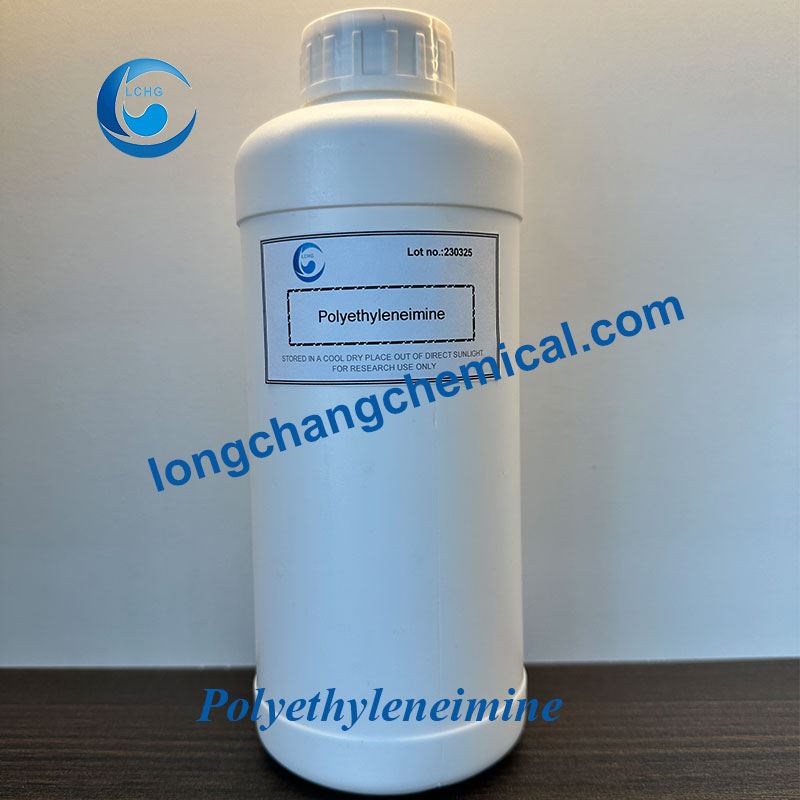
polyethyleneimine Application scenarios
1. 🔬 Biotechnology and Pharmaceuticals
• As a non-viral gene transfection vector, used to deliver nucleic acid substances such as DNA and RNA into cells.
Its positively charged amino groups can bind to negatively charged nucleic acids, forming complexes that protect the nucleic acids and promote cellular uptake.
• As a precipitating agent for proteins and nucleic acids, used for the separation and purification of biomacromolecules.
It binds to proteins and nucleic acids through electrostatic interactions, causing them to precipitate out.
• Used as a coating material for cell culture surfaces, or for preparing drug controlled-release carriers. Provides a biocompatible coating to promote cell adhesion; can form complexes for controlled drug release.
2. 🏭 Industrial Manufacturing and Processing
• Used in coatings, inks, and adhesives to improve adhesion.
The amino groups can react with various groups (such as carboxyl groups and epoxy groups) to form strong chemical bonds.
• Used as a flocculant, chelating agent, and dispersant in papermaking and water treatment.
Its cationic properties can neutralize and adsorb negatively charged impurities in water (such as fibers and anionic substances) and heavy metal ions.
• Used in textile dyeing and printing as a fixing agent and fiber treatment agent.
It binds to dyes, improving color fastness; and improves fiber properties.
• Used as a reactant for epoxy resins, an aldehyde adsorbent, and a carrier for enzyme immobilization.
The abundant primary and secondary amine groups can react with epoxy groups, aldehydes, etc.
3. 🌊 Environment and Catalysis
• Used to prepare carbon dioxide adsorption materials.
The amine groups have a capturing effect on carbon dioxide.
• Used to prepare functional materials, such as modifying nanomaterials to improve their solubility and biocompatibility. Can be used as a surface modifier to encapsulate or connect other functional molecules.


Yorumlar
Henüz yorum yok.