
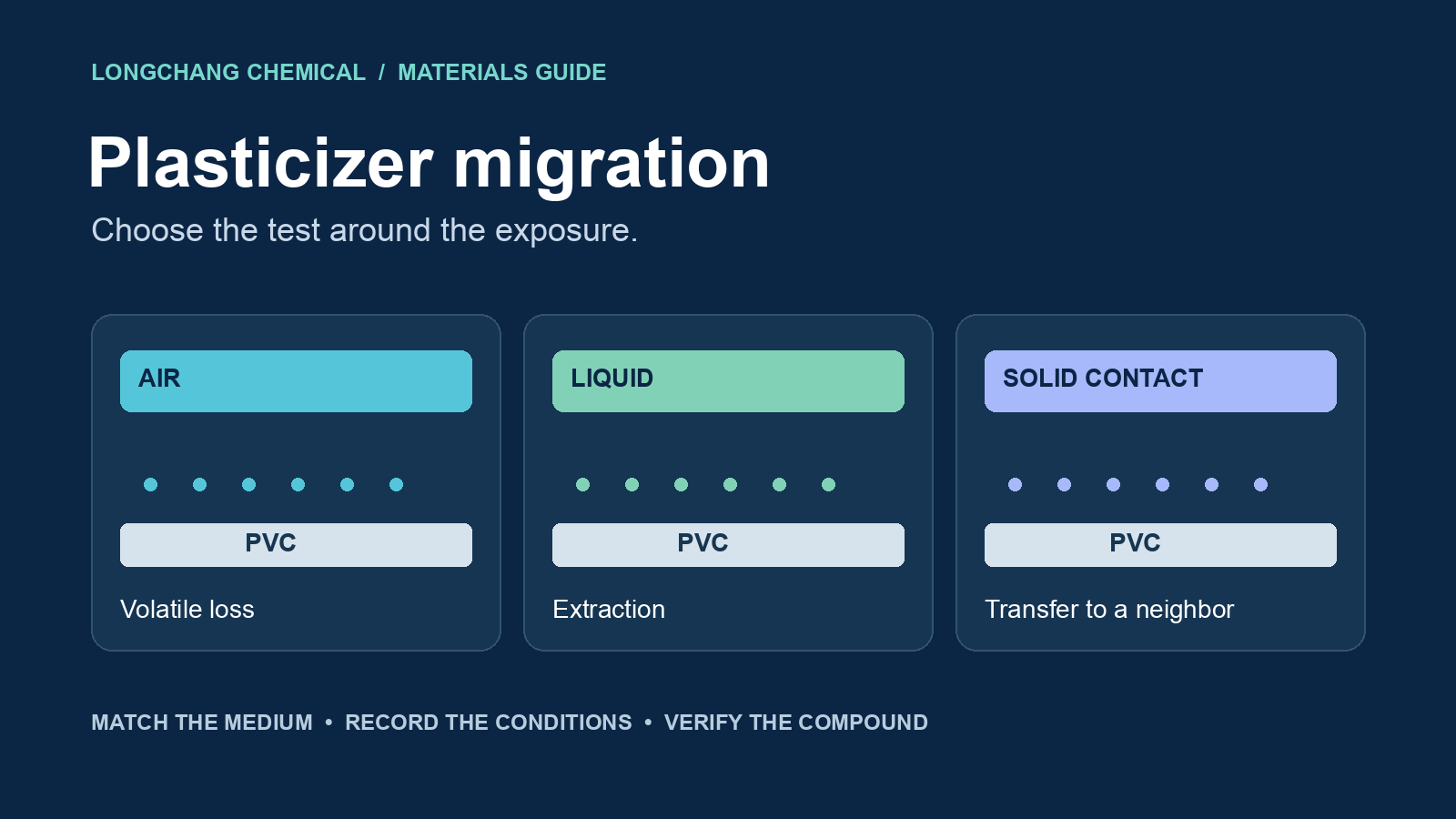
Plasticizer migration is the movement of a plasticizer out of the material it was added to soften. For a flexible PVC compound, the useful first question is where that material goes: into air, into a liquid, or into a neighboring solid. Match the evaluation to that exposure before choosing a replacement grade. A low heat-loss result alone cannot establish that a compound will resist transfer into an adhesive or coating.
This guide is for buyers and formulators investigating loss of flexibility, surface residue, or damage to a material touching flexible PVC. It provides a way to specify the investigation and compare supplier evidence. It does not assign a universal migration limit or certify a finished application.
Start with the exposure, not the plasticizer name
Write down what touches the PVC in manufacture, storage, and service. Include temporary contact: a protective film or stacked sheet can matter even if it is absent from the finished assembly. Then separate the questions your laboratory needs to answer.
| Exposure to investigate | Useful test question | What the result cannot establish alone |
|---|---|---|
| Warm air without another solid touching the specimen | How much volatile material is lost under the stated conditions? | Transfer resistance against a particular adhesive or coating |
| Contact with another solid | Does the PVC lose constituents to that contacting material? | Behavior in oil, cleaning fluid, or other liquids |
| Immersion or repeated liquid exposure | What is extracted, and how does the remaining material change? | Performance against a different liquid or under dry contact |
These are separate evaluation routes, reflected in the distinct scopes of ASTM D1203 for volatile loss, ISO 177 for migration during close contactet ASTM D1239 for extraction from plastic films. Ask the laboratory to confirm that the chosen method applies to your specimen and question; a standard number on a report is not a substitute for that check.
Confirm what moved before calling it plasticizer loss
A balance measures mass change, not chemical identity. ISO 177 notes that other constituents, including oligomers or volatile substances, can affect the result. The contacting layer may also contribute material in the opposite direction. Consequently, visible residue or a net weight change should start an investigation rather than end it.
Ask for an analytical check when the identity of the transferred material will determine your reformulation. For example, a published IR spectroscopy study of filled PVC compositions followed plasticizer migration and found that the filler system influenced its behavior. The practical implication is to test the actual compound: a plasticizer’s identity does not describe everything in the specimen.
Also keep the receiving material explicit. A study of migration from recycled PVC found that DEHP transfer into the investigated aqueous liquids was strongly limited by its solubility in those liquids. That result belongs to the tested systems. It is not evidence that the same PVC will behave identically against an oil or a polymer layer.
Make supplier reports comparable
Before ranking samples, request a report that answers the following questions. This is a purchasing checklist, not a replacement procedure for a laboratory standard.
- Which specimen? Record the resin grade, plasticizer identity and loading, other relevant additives, processing history, thickness, and exposed area.
- Which receiving phase? Identify the contact sheet, adhesive, coating, or liquid. “Migration tested” without this information is incomplete.
- Which conditions? Record the method edition, temperature, duration, conditioning, contact arrangement, and any departure from the specified method.
- Which measurement? Distinguish total specimen mass change from the measured amount of a named plasticizer. State units and the denominator used for a percentage.
- Which performance requirement? Agree on the acceptable change in flexibility, hardness, appearance, adhesion, or another relevant property before comparing the results.
- How repeatable? Request individual specimen results, replicate count, and the laboratory’s uncertainty or variability information.
For liquid extraction, note the scope carefully: ASTM D1239 measures film weight loss after chemical immersion and can reflect plasticizer or other extractable components. A generic “passed extraction” statement leaves both the exposure and the measured substance unclear.
Use a small qualification matrix to test a replacement
Our suggested screening arrangement is to retain the current production formulation as the reference and compare it with a candidate under the same relevant exposure. Keep a separately conditioned, unexposed specimen of each formulation. Record every intentional formulation change so the comparison answers a defined question.
Two comparisons serve different purposes. Holding plasticizer loading constant helps you observe what happens at that loading. Adjusting each formulation to a common initial hardness asks which system retains the desired properties. Label the comparison clearly; do not combine those results as though the formulations were identical.
For an assembly, include the real contacting material alongside any standard absorbent used in the specified method. Document this as a separate application trial if it departs from the standard. Check both sides of the interface and the property that matters to the customer. A clean-looking PVC surface is only one observation.
Illustrative calculation, not a product test: a conditioned specimen weighing 10.000 g weighs 9.970 g after an exposure and the agreed reconditioning step. The net decrease is 0.030 g, or 0.30% of the initial specimen mass. If a second specimen falls from 10.000 g to 9.990 g, its decrease is 0.10%. The second has less net mass loss in this example. Neither number, by itself, identifies the lost material or proves a longer service life.
Shortlist a grade around the result you need
Where heat exposure and durability are central to the application, CHLUMIFLEX® TOTM, CAS 3319-31-1, is a candidate to evaluate. Its product information identifies heat-resistant PVC applications, including wire and cable materials, sheets, and gaskets. Treat that application fit as a reason to request a sample and relevant data, not as proof that your finished compound passes a migration requirement.
If the project is comparing plasticizer chemistries more broadly, review the plasticizer product range after defining the exposure and acceptance criteria. For background on formulation tradeoffs, see our plasticizer types and selection guide. The migration investigation should remain tied to your actual resin, formulation, and receiving material.
For a focused technical inquiry, use the inquiry form on the relevant product page and include the PVC application, present plasticizer and loading, initial hardness, service exposure, contacting materials, observed failure, and available test report. State which property must be retained. This gives the supplier a concrete comparison to address before sample approval or price negotiation.
Questions to settle before approving the change
Does low volatility mean low migration into another material?
No single volatile-loss result answers both questions. If solid contact is the concern, request evidence for that contact, with the receiving material and exposure conditions identified.
Can I compare two migration percentages from different reports?
Only after checking the method, specimen, exposure, conditioning, and calculation basis. If those differ, ask for a common comparison rather than ranking the percentages alone.
What should the approval record contain?
Keep the accepted formulation, specimen preparation, test conditions, raw results, and application acceptance criteria together. Include unresolved observations and the scope of the approval. That record makes a later batch or supplier change much easier to evaluate.