
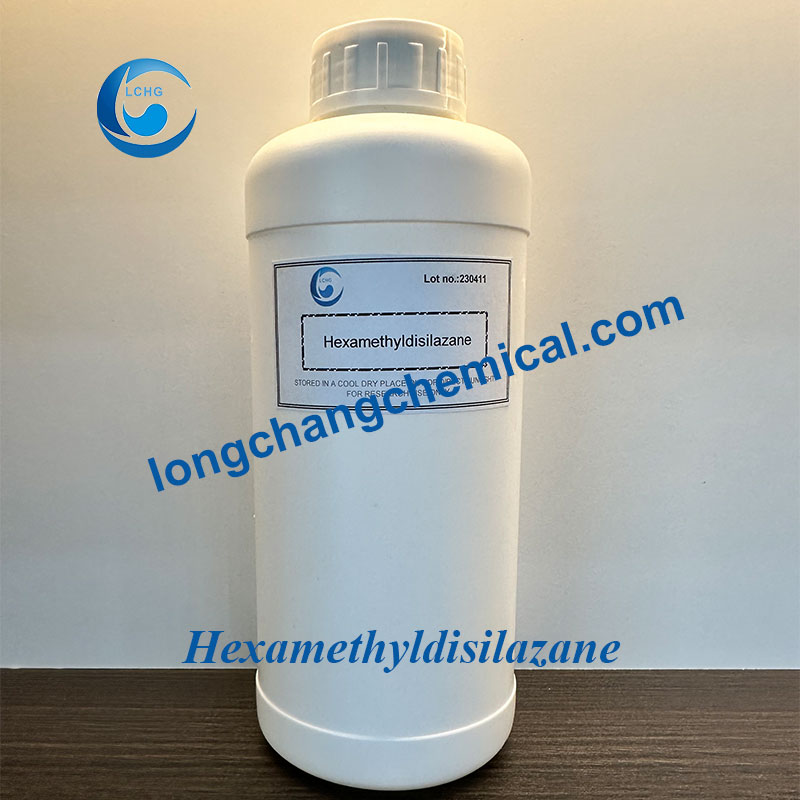
hexaméthyldisilazane Scénarios d'application
1. Industrie des semi-conducteurs et de la microélectronique
Utilisation principale :
En tant que promoteur d'adhésion (primer) pour les résines photosensibles, c'est l'une de ses applications les plus classiques et les plus répandues.
Mécanisme d'action :
Avant le processus de photolithographie dans la fabrication des puces, la vapeur de HMDS réagit avec les groupes hydroxyles (-OH) sur la surface de la plaquette de silicium, formant une couche hydrophobe. Cette couche améliore considérablement l'adhérence de la résine photosensible, empêchant le décollement du motif lors des processus ultérieurs.
2. Synthèse pharmaceutique
Utilisation principale :
Comme réactif de protection des groupes hydroxyles et aminés (réactif de silylation).
Mécanisme d'action :
Dans la synthèse organique en plusieurs étapes, le HMDS peut réagir avec les groupes hydroxyles ou aminés sensibles des molécules de médicaments, en formant des dérivés stables d'éther silylique ou de silylamine. Ces groupes sont ainsi protégés contre les réactions ultérieures et sont éliminés une fois la réaction terminée. Cette application est cruciale pour la synthèse de divers antibiotiques (tels que l'amikacine, la pénicilline, la céphalosporine) et de médicaments antitumoraux (tels que le fluorouracil).
3. Matériaux avancés et traitement de surface
Utilisation principale :
Comme agent de traitement hydrophobe de surface pour les nanomatériaux et les poudres.
Mécanisme d'action :
Le HMDS réagit avec les groupes hydroxyles à la surface du matériau (comme la silice hydratée, la silice pyrogénée, la poudre de titane, la terre de diatomée, etc. Cela améliore sa dispersibilité et sa compatibilité avec les polymères (tels que le caoutchouc), ou confère au matériau des propriétés hydrophobes et anti-décantation particulières.
4. Chimie analytique
Utilisation principale :
Comme réactif de dérivatisation pour l'analyse par chromatographie en phase gazeuse.
Mécanisme d'action :
Avant l'analyse de l'échantillon, le HMDS réagit avec les analytes contenant des groupes hydroxyles ou aminés, générant des dérivés silylés plus volatils et thermiquement stables pour améliorer la sensibilité et la précision de la détection chromatographique.
5. Batteries lithium-ion
Utilisation principale :
Comme additif fonctionnel dans les électrolytes.
Mécanisme d'action :
Grâce à son alcalinité, le HMDS peut neutraliser les substances acides (telles que le HF) produites par la décomposition de l'hexafluorophosphate de lithium (LiPF₆) dans l'électrolyte, réduisant ainsi la corrosion des matériaux de l'électrode et améliorant ainsi la durée de vie de la batterie (en particulier à des températures élevées).
6. Synthèse organique et dépôt chimique en phase vapeur
Principales utilisations :
Comme précurseur ou réactif dans la synthèse d'autres composés organosiliciés.
Mécanisme d'action :
Dans la synthèse organique spécialisée, le HMDS peut participer aux réactions en tant que source d'azote ou réactif de silylation. En outre, il peut également être utilisé comme précurseur moléculaire dans les techniques de dépôt chimique en phase vapeur (CVD) pour la préparation de matériaux en couches minces contenant du silicium, du carbone et de l'azote.


Commentaires
Il n'y a pas encore de commentaires.