
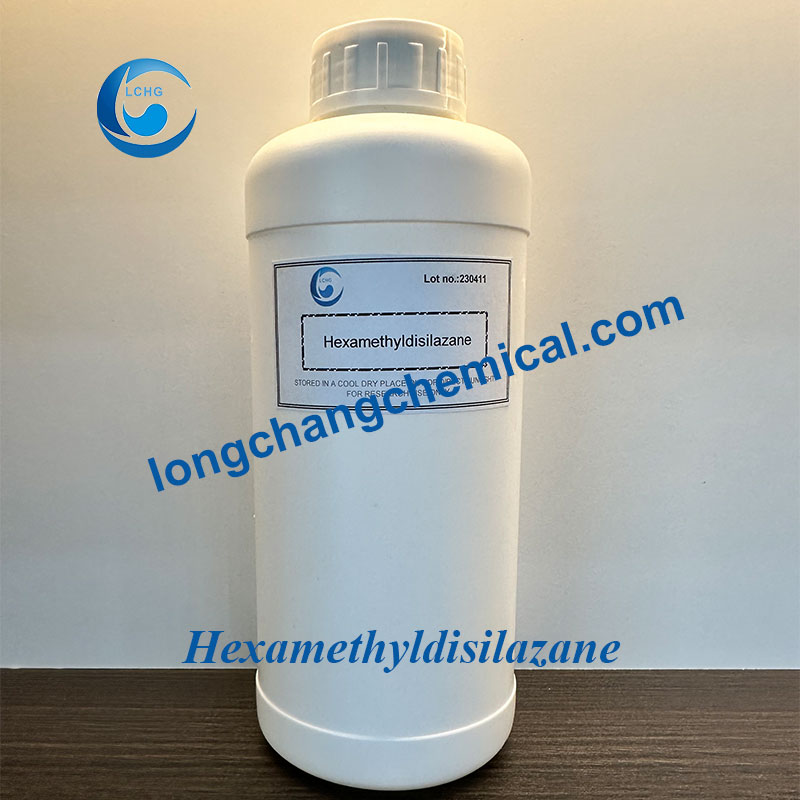
hexamethyldisilazane Application scenarios
1. Semiconductor and Microelectronics Industry
Main Use:
As an adhesion promoter (primer) for photoresists, this is one of its most classic and widespread applications.
Mechanismus der Wirkung:
Before the photolithography process in chip manufacturing, HMDS vapor reacts with hydroxyl groups (-OH) on the silicon wafer surface, forming a hydrophobic layer. This significantly enhances the adhesion of the photoresist, preventing the pattern from peeling off in subsequent processes.
2. Pharmaceutical Synthesis
Main Use:
As a protecting group reagent for hydroxyl and amino groups (silylation reagent).
Mechanismus der Wirkung:
In multi-step organic synthesis, HMDS can react with sensitive hydroxyl or amino groups in drug molecules, forming stable silyl ether or silylamine derivatives. This protects these groups from being affected in subsequent reactions, and they are removed after the reaction is complete. This application is crucial in the synthesis of various antibiotics (such as amikacin, penicillin, cephalosporin) and anti-tumor drugs (such as fluorouracil).
3. Advanced Materials and Surface Treatment
Main Use:
As a surface hydrophobic treatment agent for nanomaterials and powders.
Mechanismus der Wirkung:
HMDS reacts with hydroxyl groups on the material surface (such as hydrated silica, fumed silica, titanium powder, diatomaceous earth, etc.), changing the surface from hydrophilic to hydrophobic. This improves its dispersibility and compatibility in polymers (such as rubber), or gives the material special hydrophobic and anti-settling properties.
4. Analytische Chemie
Main Use:
As a derivatization reagent for gas chromatography analysis.
Mechanismus der Wirkung:
Before sample analysis, HMDS reacts with analytes containing hydroxyl or amino groups, generating more volatile and thermally stable silylated derivatives to improve the sensitivity and accuracy of chromatographic detection.
5. Lithium-ion Batteries
Main Use:
As a functional additive in electrolytes.
Mechanismus der Wirkung:
Using its alkalinity, HMDS can neutralize acidic substances (such as HF) produced by the decomposition of lithium hexafluorophosphate (LiPF₆) in the electrolyte, reducing corrosion of the electrode materials and thus improving the cycle life of the battery (especially at high temperatures).
6. Organic Synthesis and Chemical Vapor Deposition
Main Uses:
As a precursor or reagent in the synthesis of other organosilicon compounds.
Mechanismus der Wirkung:
In specialized organic synthesis, HMDS can participate in reactions as a nitrogen source or a silylation reagent. In addition, it can also be used as a molecular precursor in chemical vapor deposition (CVD) techniques for the preparation of silicon-, carbon-, and nitrogen-containing thin film materials.


Bewertungen
Es sind noch keine Bewertungen vorhanden.